
Controlling Your Response - Designing Your Emotional Anchors Map
An Exercise from Athletes’ Souls Self-Paced Program
Anger. Frustration. Fear. Worry. Sadness. We have all experienced emotions that feel heavy, intense, or difficult to manage. These emotions can show up after mistakes in a competition, injuries, pressure-filled moments, transitions away from sport, and many more places. Many people are never taught how to pause, ground themselves, and return to balance when emotions rise. Instead, they may try to ignore emotions, push through them, or react impulsively in the moment. This can impact your athletic performance, and over time can become mentally and emotionally exhausting.
So what can help you recenter? What can help you regain focus and stability when emotions feel overwhelming? One helpful starting point is creating an Emotional Anchors Map.

What is an Emotional Anchors Map?
An emotional anchors map is a personalized tool designed to help you identify personal cues, spaces, or actions that can help you return to balance when emotions arise. These “anchors” act as stabilizers during stressful or emotionally charged moments.
This exercise helps you pause and list, or draw, things that work for you to help you regulate, reset, and reconnect with yourself. Because emotional experiences are different for everyone, everyone’s emotional anchors map will look different. What works for one person may not work for another.
Here’s How it Works
In our self-paced course, you are walked through each exercise with a video demonstration, as well as with written step-by-step instructions. Here is a summary of the exercise for you to practice now:
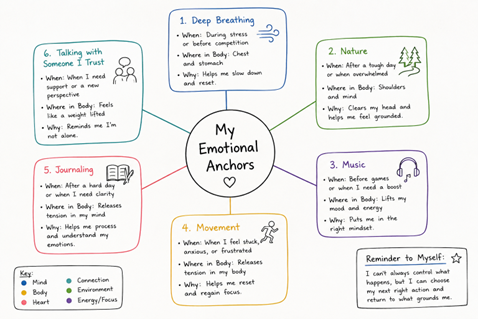
On a blank page, write “My Emotional Anchors” in the center.
Around it, draw or list 4–6 things that help you feel grounded or calm — for example: deep breathing, music, movement, nature, journaling, or talking with someone.
For each anchor, add:
a. When you use it (before, during, or after stress)
b. Where you feel the emotion (or calm) in your body
c. Why it works for you
Optional creative element: color-code your anchors by type — mind, body, heart, or connection.
Take a few moments to answer the following reflection prompts:
a. Which anchors feel strongest for you right now?
b. Which ones could you strengthen or add to your toolkit?
c. How might you remind yourself to use one in real time when you feel tension building?
Optional step to take it further: link each emotional anchor to a specific emotion or situation. For example, deep breathing with anger, or deep breathing when you think a ref makes a bad call.
Why This Works
Emotional regulation is not about avoiding emotions or pretending difficult feelings do not exist. Instead, it’s about learning how to respond to emotions intentionally and in a healthy, productive way. Grounding strategies can help regulate your nervous system, increase self-awareness, and improve focus under pressure. This is helpful during an intense training session, in the middle of a competition, at work, in your personal life, and more. Learning what your emotional patterns are and what helps you restabilize is powerful in helping you navigate challenges, both in sport and in life. It is a practical tool for you to rely on in difficult moments.
“Emotional anchors help you regulate, reset, and reconnect with yourself.”
The Takeaway
You cannot always control the situations, pressures, or emotions that arise. However, you can learn to better control how you respond to them. Whether you are still actively training and competing or are retired from sport, building awareness of your emotional anchors can strengthen emotional regulation, improve self-awareness, and help create a healthier response to stress, pressure, and adversity.
The more consistently you identify and practice the strategies that help you feel grounded, the easier it becomes to return to balance when challenges arise. Emotional regulation is a skill that develops over time, and building your personal toolkit is an important step toward both improved performance–athletic or otherwise–and well-being.
“Learning what your emotional patterns are is powerful in helping you navigate challenges, both in sport and in life.”
Want More?
Join Athletes Soul to gain full access to our free resources and self-paced course where you’ll find more exercises and tools to help you thrive in sport and in life!